A few months ago, I purchased a Tesla Model S with the latest hardware and software for Full Self-Driving (Supervised). I knew the self-driving functionality was improving based on my previous Tesla and numerous reports and articles online. I can definitively say it’s incredible.
Every day, multiple times a day, I go from point A to point B and back without ever touching the steering wheel, accelerator, or brake. It enters and exits my garage, drives down my driveway, navigates to my destinations, selects parking spots, and works seamlessly. It handles everything from surface streets to highways, stoplights, stop signs, roundabouts, and even left turns across traffic, all autonomously.
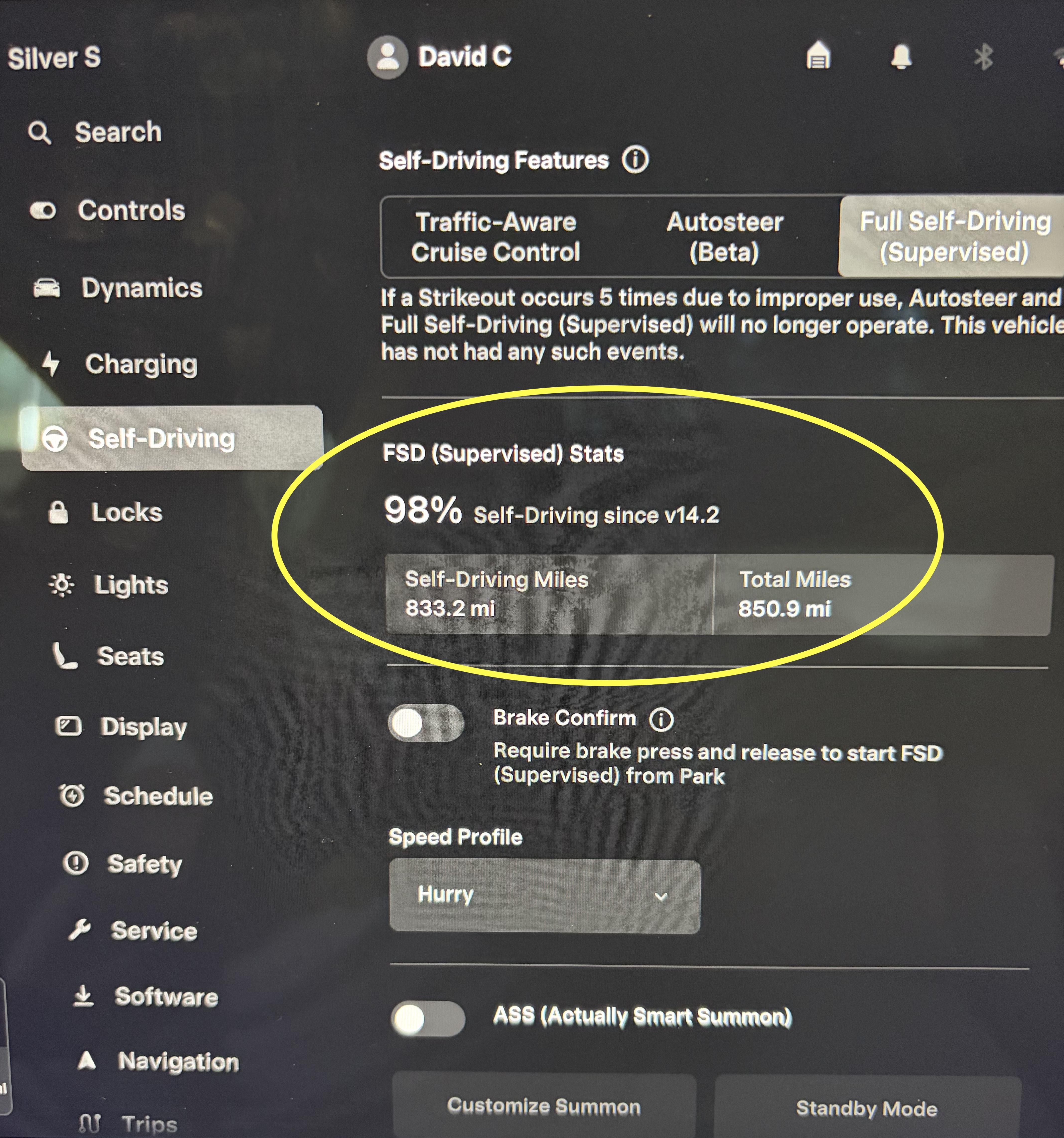
Based on the onboard computer’s data, over the last 850 miles I’ve driven, 98% of those miles were on Full Self-Driving. What about the other 2%? Google Maps. All routing depends on Google Maps, and there are a few spots where the chosen route isn’t as efficient as alternatives, so I occasionally override it with brief manual driving. Outside of these mapping issues, it’s truly a sit-back-and-enjoy-the-ride experience.
Given how good the experience is, I’ve been sharing my learnings with friends and family and offering test drives to anyone interested. I explain that it does everything needed and has completely changed my view of driving. I never want to drive a car again for the purpose of getting from A to B. I will never buy another car that doesn’t have self-driving capabilities, and I wouldn’t recommend anyone buy a car without it. It doesn’t have to be a Tesla, but purchasing a vehicle that can’t safely drive itself no longer makes sense.
I liken it to the era of flip phones and the introduction of the iPhone. Once people experienced the iPhone, its apps, intuitiveness, and overall richness, they never went back. Just as I would never return to a flip phone, I wouldn’t go back to a car that doesn’t drive itself.
Self-driving is safer. The vehicle uses 360-degree cameras to monitor all directions at all times. It reads speed limit signs, understands upcoming stoplights and stop signs through mapping and onboard systems, identifies open parking spots, and can even open my garage door and back all the way in. My stress levels are lower, my anxiety about traffic is reduced, and my overall peace of mind, especially from a safety perspective, is higher.
At the same time, this has been a reminder of how difficult it is to change human behavior. I’ve shared these benefits, safety, reduced stress, and improved quality of life, with many people. Some have asked questions, and several have experienced it firsthand. But after months of this, there hasn’t been a single taker. Not one person has switched their daily driver to a self-driving car.
Some don’t like the brand. Some don’t like the interior. Some are hesitant about switching to an electric vehicle. Others simply have inertia. Even with a clearly superior, safer, and more pleasant experience, one that represents the future, there have been no takers.
Change in human behavior is incredibly difficult.
This experience has also reinforced that the diffusion of clearly superior technology takes much longer than expected. It’s similar to the idea that people overestimate what they can accomplish in a year and underestimate what they can accomplish in ten years. The same applies to technology adoption. Crossing the chasm is no easier today than it was decades ago.
Self-driving cars are here today and work incredibly well. They will be commonplace in the future. But human behavior changes slowly, and that gap between what’s possible and what’s adopted represents both the challenge and the opportunity.
For entrepreneurs, the lesson is clear: even with a 10x better solution that is already working in customers’ hands, achieving mainstream adoption takes time. Self-driving cars are already on the road and performing at a high level, yet it may take a decade or more to reach widespread adoption.
Entrepreneurs would do well to keep this in mind as they work to change the world.


Leave a Reply