Category: Corp Culture

  • Holacracy as the Next Startup Corporate Structure

    Ev Williams, the co-founder of Twitter, has a new company called Medium where there are no managers. This idea of a leaderless organization isn’t new but it’s also far from commonplace. Perhaps the best known organization without managers is Valve Software, which published an amazing employee handbook that describes how it works. FRC Review has a new post up where they outline how it works at Medium without managers using this idea of a Holacracy approach to corporate structure.

    Here are some of the key takeaways for Holacracy from the FRC Review article:

    • No people managers. Maximum autonomy.
    • Organic expansion. When a job gets too big, hire another person.
    • Tension resolution. Identify issues people are facing, write them down, and resolve them systematically.
    • Make everything explicit – from vacation policies to decision makers in each area.
    • Distribute decision-making power and discourage consensus seeking.
    • Eliminate all the extraneous factors that worry people so they can focus on work.

    Instead of top-down, command-and-control structure, everything is composed of nested circles. A circle can be one person that owns some aspect of the business or it can be a group of people that own it. If a Holacratic organization sounds familiar, it’s because it’s a blend of two things I’m a big believer in: results only work environments (ROWE) and the value of autonomy, mastery, and purpose. Only, it takes it one step further and gets rid of the concept of a traditional hierarchy and instead makes it so that circles, composed of one or more people, make any and all decisions.

    Holacracy is a great idea and I’m looking forward to watching it evolve.

    What else? What are your thoughts on Holacracy as a corporate structure?
  • Powerful Perks: Annually Pay for an Industry Conference

    One of the more interesting perks to offer in a growing startup is to provide a stipend for each team member to attend a conference of their choosing once a year. By paying for a conference, it promotes employees learning new things, meeting new people, and gaining exposure to new ideas. It also shows that the company values individuals progressing in their career and advancing their craft.

    Here are a few ideas to keep in mind when offering a paid annual industry conference trip:

    • Budget wise, keep it simple and offer a set allotment like $2,000 to empower the person to take a quality trip to an interesting conference (the goal isn’t to spend all the money but rather to have good options)
    • Consider not having a set budget and simply expensing reasonable costs
    • Make it clear that the money should be treated as if it’s their own and isn’t designed to pay for flying first class and staying at the Ritz Carlton
    • Don’t have the money roll over if it isn’t used as the goal is to annually get away and better one’s craft
    • Don’t require that the conference be perfectly aligned with what the person currently does, but do require that it be at least relevant (e.g. a Java developer might want to attend a Ruby conference to learn more about the language)
    • Don’t put too many rules around the program as it’s important people use it and not feel it’s too much effort

    When evaluating potential perks for a growing startup, consider offering an annual stipend to attend a conference. Team members value the perk and that the company is investing in their future.

    What else? What are your thoughts on the perk of paying for an annual industry conference?

  • Culture First or Find Customers First

    Recently there was a local debate around the importance of corporate culture in the earliest days of seed stage startups. From the debate, there was contention about whether or not a focus on culture at the start was important before the business had many employees and was viable. Put another way, should you spend any time on culture when it could be spent acquiring customers?

    My answer: absolutely, culture matters from the beginning. Culture is more than just the founders and people hired. Yes, the people are the most important part, but culture is reflected in the core values, processes, and the way the company chooses to act. The same exact team with different core values, assuming the values are truly cared about, will act differently because the priorities are different.

    The culture won’t last long if the startup goes out of business but it also won’t be nearly as fun if things are successful and the culture isn’t strong and cohesive. Culture also sets the tone and foundation for the future of the startup. Entrepreneurs should be intentional about culture from the beginning while not using it as a crutch to avoid working on the hard problems to build a sustainable business. As with anything, there’s a balance between working on the business vs in the business.

    What else? What are your thoughts on focusing on culture first or finding customers first?

  • When Does the Millennial Workplace and Culture Become Standard

    Earlier today I was talking to a colleague about the environment at the Atlanta Tech Village and how it was the ideal place for Millennials. It’s not that we’re anti-establishment, but more so that we’re working on creating the best environment possible for how we want to work.

    Here are a few characteristics of the modern Millennial workplace and culture:

    • Creative and collaborative rooms, open spaces, and multiple work options (less private space and more communal space)
    • Tools to work whenever, wherever (thanks to the cloud and mobile technology)
    • Strong transparency and openness
    • Results only work environment
    • Focus on autonomy, mastery, and purpose

    Now, we’re likely in the first inning of this type of environment becoming more commonplace, but it’s going to happen.

    What else? When do you think the millennial workplace and culture will become more standard?

  • Core Values Aren’t a New Concept

    I love talking about core values. You know, the essence of the people in an organization. At the Atlanta Tech Village, we can’t pick good ideas from bad, but we can create an environment that follows these four core values: be nice, dream big, pay it forward, and work hard/play hard. Some people don’t understand the importance of strong core values, and that’s fine. I’ll keep preaching anyway.

    Yesterday I was listening to a colleague tell the story of Mindspring/Earthlink in the early days. The Mindspring founder, Charles Brewer, was fanatical about their core values, and rightly so. Back in 1994, when he started the company, the first thing he did is define the core values, before he even decided the nature of the business! At it’s peak, Mindspring had over 1,000 people, and hired in a way that kept their culture strong and customer service great.

    It took me seven years to appreciate the importance of strong core values. In retrospect, core values aren’t a new concept and I just needed to experience things not working to feel the pain and search for a solution. Well, for the entrepreneurs in the audience, core values are a proven concept and they really matter. Trust me.

    What else? What are some other examples of companies that have had strong core values for decades?

  • Atlanta Tech Village as Instant Community

    Recently I was talking to an entrepreneur that was excited about moving into the Atlanta Tech Village. Me being naturally curious, I asked the entrepreneur what made it so exciting. Immediately, the entrepreneur said that it provided instant community for their employees. I probed deeper and quickly found that by having a small number of employees, it’s hard to have a critical mass to do programs, events, and build community.

    Here are examples of instant community at the Atlanta Tech Village:

    • Weekly Friday lunches at Startup Chowdown
    • Running club
    • Weekly huddle groups for subjects like sales, marketing, and software engineering
    • Frequent happy hours
    • Regular office hours with subject matter experts
    • Multiple events and programs each week

    The idea is that when you join a larger company, there are so many people and resources that help create community. Startups don’t have the same luxury, until now — Atlanta Tech Village provides an instant community.

    What else? What are your thoughts on an instant community for startups?

  • It’s All About the People

    Earlier today I was talking with some colleagues about cultures at different startups. One company was mentioned and everyone promptly said they knew someone that used to work there and didn’t have a good experience. Now, the takeaway isn’t that the company doesn’t have a strong culture, rather, they bring on people that aren’t a good fit, and those people often self-select out. The stronger the culture, the more people that don’t fit because it’s so well defined and tight. Two successful companies can have very different cultures.

    In a startup, and every business, it’s all about the people.

    Ask anyone about their job and what’s the first thing they say? They say the people are great (assuming they like the job). Things like the market opportunity, compensation, and office environment always come after how they feel about the people. What’s the number one reason cited for people quitting a job? Answer: dislike of their manager. It all comes down to people.

    What else? Do you agree that it’s all about the people?

  • Week One With an Open Floor Plan Office Environment

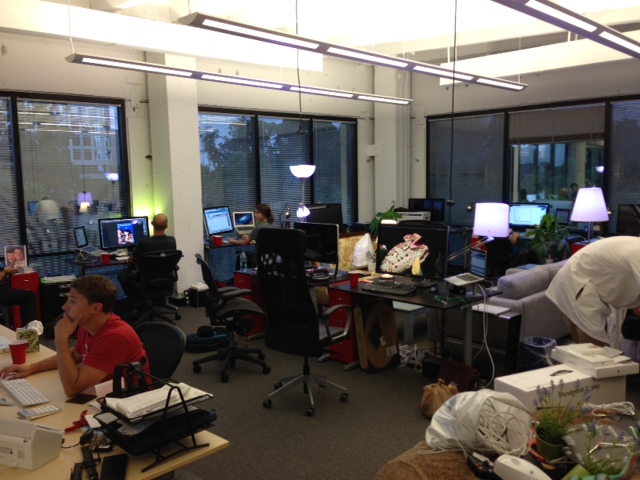
    We’re almost a week into our open floor plan arrangement and I must say that things are better than expected. I knew it would increase communication, and distractions, but the value of sharing information and helping each other out has outweighed the cons. Just being in the room has energy and excitement in the air — mostly a testament to the culture and quality of our people, but also related to the work environment.

    Way back in May of 2010, Jeff Hilimire blogged that’d he’d never go back to private office again. I remember reading that the day he wrote it and thinking to myself that I’d like to try that out as well. Well, three years later I finally made it happen.

    Here’s what I’ve learned so far with an open floor plan office environment:

    • Collaboration and talking amongst team members goes up (as expected)
    • People follow our posted best practices guidelines (respect those around you, no talking on the phone in the large rooms, headphones on means do not disturb, etc)
    • Private meeting rooms are always available with a ratio of one room for every five people (I haven’t seen more than four of the eight meeting rooms used at any given time)
    • Tasks which require long, uninterrupted focus I take to a private room or a different area

    My biggest takeaway is that the open floor plan environment works best in conjunction with a Results Only Work Environment (ROWE) philosophy. When team members are empowered to get their work done in a matter best suited to how they like to work, an open office floor plan is just one of many options.

    Here’s a photo:

    open floorplan office

    Some of the highlights included tons of natural light, exposed ductwork with 12 foot ceilings, drop lights that shoot light back on the white ceiling so that there’s all indirect light in the room, retractable power cords mounted on the ceiling for maximum flexibility in rearranging desks, and carpet on the floor to absorb sound. Overall, the space looks amazing and I’m excited how it turned out.

    What else? What other experiences do you have with open floor plan office environments?

  • Strong Employee Loyalty as an Atlanta Startup Strength

    When thinking about startup strengths for Atlanta, everyone knows the common ones like low cost of living, great Georgia Tech talent, abundant young professionals, and general excitement in the community. There’s another Atlanta startup strength that needs more coverage: strong employee loyalty.

    Here are a few thoughts on strong employee loyalty as an Atlanta startup strength:

    • Part of Atlanta’s Southern culture is a focus on people and relationships, which results in more emphasis on the team and less on jumping ship to the hotter startup down the road
    • Tech talent is at a premium and there’s a real shortage of software engineers, making strong employee loyalty more important than people realize
    • Training a new employee often costs 10 – 20% of first year’s salary, making it an expensive proposition that increases the value of employee retention
    • Referrals are the best source for new hires and loyal employees are more likely to recommend friends

    Of course, things like a great corporate culture, awesome mission, and competitive wages are a pre-requisite for strong employee loyalty regardless of location. Strong employee loyalty is an Atlanta startup strength compared to the top high tech centers in the country.

    What else? What are your thoughts on strong employee loyalty as an Atlanta startup strength?

  • Startup Style – Open Floorplans with No Private Offices

    In two weeks we’re moving into a newly renovated suite in the Atlanta Tech Village with a number of cool features like 12 foot ceilings, exposed duct work, indirect lighting, iPads outside all meeting rooms/phone booth rooms, seven 70 inch LED TVs mounted on the walls, and an open floorplan with no private offices. I’ve been a part of a number of cool, interesting offices but this will be the first time I’ve tried the open floorplan with no private offices.

    Design wise, we’ll have 40 desks total split into two large rooms with 25 and 15 desks respectively. Then, on the interior perimeter of the suite, we have three phone booths (tiny rooms for personal calls, cold calling, web demos, etc), four team rooms that support up to four people per room, and one board room that supports 14+ people. So, seven shared rooms for 40 people. Assuming 12 people are gone on any given day working from home, on vacation, at a trade show, etc. that leaves a ratio of one shared private room per four people, which feels like plenty right now (we can squeeze in more desks in the open floor plan eventually).

    Naturally, there are concerns about noise, personal space, and interruptions. We’ll have high quality white noise machines, sound boards, rollable partitions, and plenty of furniture to help with some of the noise but a loud conversation will still carry throughout the space. Part of the process will be unwinding general tendencies to collaborate right on the spot in the open area and instead move to the one of the break out rooms (the different rooms will be equipped with white board paint and iMacs to enhance their usefulness).

    Open floorplans with no private offices are still rare but slowly growing in popularity, especially in the startup world. It’s a new change for me and I’m looking forward to it.

    What else? What are your thoughts on open floorplans with no private offices?