Category: SaaS

  • Faster SaaS Growth Equals Greater Losses

    Continuing with yesterday’s post on Gross Margin as Part of Lifetime Customer ValueDavid Skok has a important post up titled SaaS Metrics 2.0. In the article, he touches on a critical topic that isn’t well understood: faster SaaS growth equals greater losses. Here’s how he visualizes it:saas_growth

    The idea is that when you sign a new customer, there’s a payback period, which is why gross margin is an important consideration. New SaaS customers are money losers for an extended period of time — often one year — but then are very profitable after that. Intuitively, this makes sense as payments are spread out over time. So, if you lose $X for a new customer until they’re profitable, it only follows that if you sign five times the number of customers, you’re going to lose $5x until they’re profitable (more customer onboarding help, more servers, more infrastructure, etc.).

    Entrepreneurs would do well to understand that faster SaaS growth equals greater losses, and that it should be planned for accordingly.

    What else? What are some more thoughts on faster SaaS growth equaling greater losses?
  • Gross Margin as Part of Lifetime Customer Value

    Continuing with yesterday’s post on SaaS CAC to LTV Metric, there’s another important element that needs to be addressed: gross margin. Gross margin is the percent of revenue left over after taking out the costs required to serve the customer (SaaS cost of goods sold). So, a company having gross margins of 70%+ (as SaaS companies should have), will have more money, as a percent of revenue, to dedicate to acquiring new customers.

    In the context of the lifetime value (LTV) of a customer, a company with 90% gross margins has a much more valuable customer than a company with 70% gross margin (or a lower gross margin, as is often the case).

    When talking about SaaS CAC to LTV, it’s actually better stated as CAC to the LTV gross margin. The idea for the ratio is how efficiently customers are acquired. Well, companies with very different gross margins shouldn’t be comparing their CAC to LTV ratios. Rather, CAC to LTV gross margin ratio would be a better comparison.

    The next time you’re talking about the lifetime value of a customer, talk about the gross margin of the lifetime value of a customer.

    What else? What are some more thoughts on incorporating gross margin into the lifetime value of a customer?

  • SaaS CAC to LTV Metric

    Continuing with The Magic Number for SaaS, there’s another phrase that’s bandied around quite a bit: CAC to LTV. Here’s a quick definition of CAC and LTV:

    • CAC – Cost of customer acquisition (how much it costs to get a customer, on average)
    • LTV – Lifetime value of the customer (how much the customer pays, on average, over the period of time they’re a customer)

    When people talk about CAC to LTV, they mean the ratio of the cost to acquire a customer relative to how much a customer pays over time. Generally, the question is whether or not the company can profitably acquire customers. For several years, often when the startup is sub-scale or investing in growth ahead of profitability, the cost to acquire a customer exceeds the value of the customer. CAC to LTV is an important measure of the efficiency of the business model, especially as it pertains to the repeatable customer acquisition model stage in a startup.

    CAC to LTV is one of the most important metrics for SaaS entrepreneurs and should be well understood.

    What else? What are some more thoughts on the SaaS CAC to LTV metric?

  • The Magic Number for SaaS

    Way back in 2008 Lars Leckie published a seminal piece on SaaS metrics titled Magic Number for SaaS Companies. From the piece, here are the stages of evolution of the company:

    1. Product: build a rock solid product. Prove you can sell it as founders before moving past this step.
    2. Sell: Sell like crazy, build out a team, hire some QBSRs (Quota Bearing Sales Reps)
    3. Retention: focus on churn and retention issues, hire more QBSRs
    4. Marketing: spend on marketing, hire more QBSRs

    Then, on to the magic number. The magic number is a ratio of the scaling of recurring revenue to the sales and marketing spend. Here’s the formula:

    (Quarterly Revenue – Previous Quarter Revenue)*4 / (Previous Quarter Total Sales and Marketing Expense)

    So, take the growth in revenue between the quarters, annualize it by multiplying by four, then divide by the total of all sales and marketing expenses. If this number is greater than 1, things are going well and more should be spent on sales and marketing. If this number is less than 1, the cost of customer acquisition relative to the value of the customer is too high and the focus should be on making sales and marketing for effective.

    Scaling a SaaS startup is expensive. Use the SaaS Magic Number to understand how efficiently the business is growing based on relative growth to customer acquisition costs.

    What else? What are some more thoughts on the SaaS Magic Number?

  • Pardot Revenue in the First Six Years

    Continuing with yesterday’s post on Compounding Growth, let’s look at a real-world example of revenue growth: Pardot’s revenue in the first six years. This example shows that the growth rate is strong, but not constant, and is also helpful for entrepreneurs that are putting together financial plans to see what a SaaS startup did almost 10 years ago (too often, entrepreneurs put together exaggerated revenue growth forecasts in their executive summaries).

    Here’s the approximate recognized revenue for Pardot in the first six years:

    • 2007 – $2,000
    • 2008 – $400,000
    • 2009 – $1.2 million
    • 2010 – $3.2 million
    • 2011 – $7.4 million
    • 2012 – $13 million

    Today, Pardot is significantly more than 10x larger than the 2012 revenue amount only four years post acquisition.

    Even for startup success stories, growth rates aren’t consistent. The key is to grow large enough and fast enough so that the business is both meaningful and sustainable.

    What else? What are some more thoughts on Pardot’s revenue in the first six years?

  • The Importance of Customer Success

    At Pardot, one of the areas where we really excelled was customer success. Back then, we referred to customer success as client advocacy, but the idea was the same: proactively help our customers have a great experience. Customer success is one of the most important functions, yet not as well understood as other functions.

    Here are a few thoughts on customer success:

    • Implement a customer success platform to ensure consistent and efficient customer interaction as well as customer analytics (Need a product? Check out Trustfuel)
    • Develop a cadence around on-boarding, regular outreach, and renewal period
    • Build a pipeline for the customer success team through sales development reps that are a great culture fit but choose not to go in sales as well as support reps that want to proactively help customers
    • Decide who’s going to handle up-selling and cross-selling as it’s not usually the same skill set as a customer success manager
    • Scale the customer success team as the number of customers grows (depending on the type of customer, one benchmark is one customer success manager (CSM) for every $1 million in annual recurring revenue)

    Remember that with Software-as-a-Service, the “service” is just as important as the “software.” Customer success is critically important.

    What else? What are some more thoughts on the importance of customer success?

  • Agile vs. Burndown Software Development

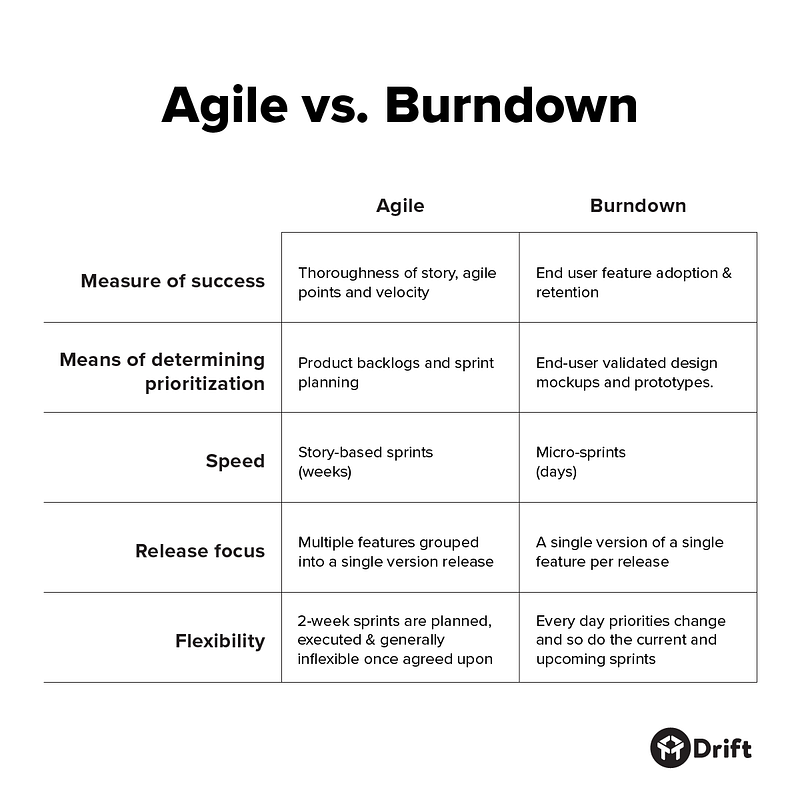
    Matt Bilotti has a great post titled How We Build Products at Drift. The crux of the article is that there’s a new, and better, way to do software development: burndown. Today, in the startup world, agile is the most common software development methodology. Only, it’s centered around the two week sprint, and the reality is that the customer feedback loop is much faster than two weeks.

    Here’s the breakdown on agile vs. burndown from the post:

    • Measure of success
      • Agile – Thoroughness of story, agile points and velocity
      • Burndown – End user feature adoption & retention
    • Means of determining prioritization
      • Agile – Product backlogs and sprint planning
      • Burndown – End user validated design mockups and prototypes.
    • Speed
      • Agile – Story-based sprints (weeks)
      • Burndown – Micro-sprints (days)
    • Release focus
      • Agile – Multiple features grouped into a single release version
      • Burndown – A single version of a single feature per release
    • Flexibility
      • Agile – 2-week sprints are planned, executed & generally inflexible once agreed upon
      • Burndown – Every day priorities change and so do the current and upcoming sprints

    Feel like the agile software development methodology isn’t quite right for your team? Consider trying out some of these burndown concepts.

    What else? What are some more thoughts on agile vs. burndown methodologies?

  • Notes from the Coupa S-1 IPO Filing

    Coupa, a SaaS spend management platform, just published their S-1 IPO filing to go public. Seeing the filing makes me sentimental as I first learned about them in 2009 when they become one of our early Pardot customers and we were at similar stages with our respective startups. Now, with over $100 million in recurring revenue and a strong growth rate, Coupa is positioned for a solid IPO.

    Here are a few notes from the Coupa S-1 IPO filing:

    • Mission – Our mission is to deliver “Value as a Service” by helping our customers maximize their spend under management, achieve significant cost savings and drive profitability. (pg. 1)
    • 460 customers, 1.5 million users, and 2 million suppliers (pg. 1)
    • We refer to the process companies use to purchase goods and services as spend management (pg. 1)
    • Revenues and net losses: (pg. 2)
      • Revenues
        • 2014 – $50.8 million
        • 2015 – $83.7 million
        • 1H 2016 – $60.3 million ($120.6 million annualized divided by 460 customers makes for an average of $262,000/customer/year)
      • Net losses
        • 2014 – $27.3 million
        • 2015 – $46.2 million
        • 1H 2016 – $24.3 million
    • Competitive strengths: (pg. 7)
      • Easy and Intuitive User Interface that Enables Widespread Employee Adoption.
      • Unified Platform With Powerful Functionality.
      • Independence and Interoperability.
      • Powerful Network Effects.
      • Cloud Platform.
      • Rich Partner Ecosystem.
      • Results-Driven Culture.
      • Higher Supplier Adoption.
      • Proprietary Data Enables Superior Insights.
    •  Accumulated deficit of $147.2 million at July 31, 2016 (pg. 16)
    • In general, the upfront costs associated with new customers are higher in the first year than the aggregate revenues we recognize from those new customers in the first year. (pg. 19)
    • We have funded our operations since inception primarily through equity financings and prepayments by customers. (pg. 30)
    • Equity (pg. 121)
      • CEO/Chairman (non-founder): 5.8%
      • VCs – 59%
      • Mutual Funds – 5.1%

    Congrats to the Coupa team on building a meaningful, fast-growing SaaS company. My guess is that Coupa has a strong IPO and gets acquired by someone like Salesforce.com, Oracle, or Microsoft in the next 24 months as they look to expand their SaaS portfolio.

  • The Three Main Functional Categories for B2B SaaS Apps

    When analyzing B2B SaaS opportunities, I like to think through things like nice-to-have vs must-have, market size, point on the lifecycle adoption curve, etc. There’s another area that I like to bucket SaaS apps: functional categories. Functional categories are a big, general way to think about what the app does and how it fits in with the user.

    Here are the three main functional categories for B2B SaaS apps:

    • Major Job Function (Workflow) – This is for apps where the app is one of the top three apps used daily by the person (e.g. SalesLoft and Gmail would be the main apps for an SDR).
    • Specialized Job Function – This is for apps where the app is used at least weekly to accomplish a function but aren’t an app that the end user “lives” in daily (e.g. Calendly for automating meeting scheduling).
    • Utility – This is for apps that are always running in the background acting as a utility for a specific function (e.g. Rigor for performance monitoring).

    Look at the public SaaS companies and you’ll be able to easily categorize each one into one of the three main functional categories for SaaS apps. Also of note is that the largest SaaS companies by revenue are all major job function apps (there are plenty of successful specialized job function and utility apps as well, but they aren’t nearly as large as the major job function apps).

    What else? What are some more thoughts on the three main functional SaaS app categories?

  • 5 Choice Quotes in From Impossible to Inevitable

    Aaron Ross and Jason Lemkin have a great book out titled From Impossible to Inevitable: How Hyper-Growth Companies Create Predictable Revenue. Now, it’s a mixture of the good stuff from the book Predictable Revenue and the site SaaStr, which are both must-reads for entrepreneurs.

    Here are five choice quotes from the book:

    1. It’s always better to “show” rather than “tell” (stop talking and prove it).
    2. It takes three to six months to go from scratch to consistent pipeline generation — and longer for revenue. Stick it out!
    3. When you do something new, hire two. With one person, you can’t tell if what is working is due to the person or to the process.
    4. You’ll fail in SaaS if you don’t commit to spending 24 months to achieve initial traction.
    5. When you’re pursuing anything vitally important to you, you can figure it out when you embrace the challenge and growth rather than avoid it.

    Haven’t read the book? Head over to Amazon.com and purchase From Impossible to Inevitable: How Hyper-Growth Companies Create Predictable Revenue.

    What else? What are some more great quotes from the book?