Blog

  • Seven Spectrum of Outcomes for AI

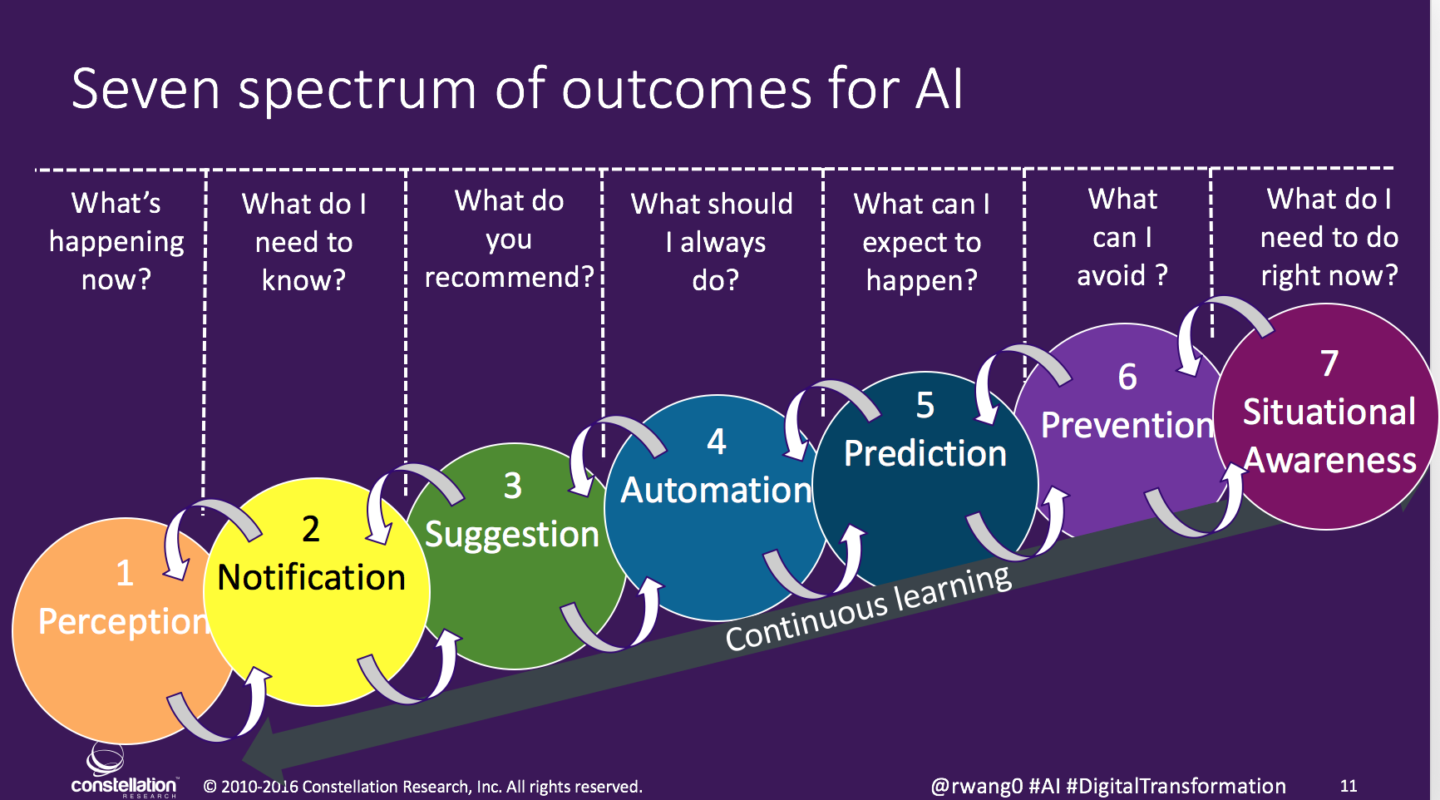
    Ray Wang has an interesting post up titled Understand The Spectrum Of Seven Artificial Intelligence Outcomes. From the post, here are the seven:

    1. Perception – What’s happening now?
    2. Notification – What do I need to know?
    3. Suggestion – What do you recommend?
    4. Automation – What should I always do?
    5. Prediction – What can I expect to happen?
    6. Prevention – What can I avoid?
    7. Situational Awareness – What do I need to do right now?

    rwang0-spectrum-of-outcomes-for-ai-1440x800

    Just think of how artificial intelligence is applied to every B2B SaaS application using these seven questions as a thought exercise — there are so many amazing possibilities.

    It’s a great time to be an entrepreneur.

  • 8 Questions to Ask at an Annual Financial Plan Review

    After reviewing a number of annual financial plans, both department and company-wide, I’ve created a list of questions to ask in an attempt to help think through the high-level topics and generally make sure things make sense. A financial plan is a detailed financial model incorporating a number of elements like assumptions (e.g. ratios of account executives to sales development reps), budget line items, and specific targets (e.g. sales).

    Here are eight questions to ask at an annual financial plan review:

    1. What are the top three takeaways from the plan? What’s the big picture?
    2. What are the biggest risks? What are the biggest differences from the prior year results?
    3. Are the ratios and assumptions in the range of other similar startups (e.g. percent of company in product development as compared to other SaaS startups)?
    4. Does the burn rate and the corresponding revenue growth make sense (e.g. the growth in recurring revenue should at least be larger than burn, if not a multiple of it)?
    5. Is the hiring plan achievable? Is there a pipeline of candidates already in place?
    6. What financing has to take place during the year, if any? Is there enough time to run a process?
    7. What product enhancements need to happen to achieve key targets like renewal rate and average revenue per account?
    8. What do the key metrics like revenue, revenue growth rate, gross margin, and churn rate look like? Are they trending in the right direction?

    Annual financial plans are critical for startups, especially post product/market fit. Ask these eight questions and work to understand the big picture.

    What else? What are some questions to ask at an annual financial plan review?

  • Final End of the Year Review

    Now that we’re in the last week of the calendar year, it’s time for one last end of the year review. As an entrepreneur, there are so many things going on that it’s easy to not stop and take care of the basics. Here are a few ideas to put on your end of year review:

    • Thank your friends and family for all the support they provide
    • Tell your employees and team members how much you value them
    • Reach out to your board, advisors, mentors, and coaches and tell them what they mean to you
    • Polish your Simplified One Page Strategic Plan one last time
    • Plan you New Year’s resolutions (and implement a plan to stick to them!)
    • Review the year and ask the start, stop, continue questions

    The end of the year is a great time to reflect and review. Take a few minutes and make it count.

    What else? What are some more end of year items to review?

  • Merry Christmas – Creativity, Inc.

    Merry Christmas! Here’s a fun talk on Creativity, Inc. by Ed Catmull. Enjoy!

    From YouTube: Ed Catmull, president of Walt Disney and Pixar Animation Studios, shares some of his formative career experiences and offers a glimpse inside the working culture of Disney and Pixar. In conversation with Stanford Professor Bob Sutton, Catmull offers additional insights from his book, Creativity, Inc., including lessons learned from his longtime working relationship with the late Steve Jobs.

  • Finding a Work/Life Blend

    Recently an entrepreneur asked me for ideas and tips about work/life balance. I replied that balance implies that they’re constantly aligned, which I don’t think is the case. Things regularly ebb and flow, requiring a work/life blend with some guidelines around them.

    Here are a few strategies I use for work/life blend:

    • Written plan and expectations with spouse (alignment is key)
    • Limit morning and evenings events to one per week average over the course of the month (e.g. if I have two evening events one week, I’ll work to have none the next week)
    • Limit work travel to 5-10 nights per quarter (often for tradeshows or visiting a customer/partner)
    • Weekly date night (key is to get out of the house without the kids)
    • Quarterly family vacation (go out of town for a long weekend or on a week long trip)
    • Continually ask the start, stop, and continue questions

    A work/life blend is personal to everyone’s unique situations. After years of refinement, this approach has worked for me.

    What else? What are some more thoughts on finding work/life blend?

  • Thinking About SaaS Run Rates and Renewal Rates for the New Year

    One of the great things about SaaS is that the new revenue layers on top of existing revenue such that the new year starts with a baseline of business even if nothing new is sold. As I talk to entrepreneurs and ask about 2017, they like to talk about revenue going from X to Y next year (e.g. $1M to $2M). Then, I ask about their annualized renewal rate, which is often in the 70% – 90% range (anything above 90% is amazing). Taking that annual renewal rate and multiplying it by the end-of-year run rate is a better way to think about the starting point for the new year.

    Here are a few thoughts on the SaaS run rate for the new year in the context of the renewal rate:

    • Most of the time, the renewal rate with existing customer expansion revenue layered on is well below 100% (meaning, if no new deals are sold in a calendar year, the company would shrink as opposed to some startups which are great at growing existing customers and continue to grow even if they didn’t sign new customers)
    • Thinking about the run rate times the renewal rate as the starting point creates a more realistic baseline for the new year (e.g. $10M run rate and 80% renewal rate with a goal of hitting $15M by the end of 2017, it’s better to think of starting at $8M and needing to add $7M of new revenue to get to the 2017 goal even though it’s conservative since the 20% that cancel won’t do so on day one)
    • Talking about the new year run rate with a renewal rate context drives home the importance of product development, customer success, support, etc. in delivering an amazing experience where customers will not only renew, but they’ll also want to expand

    Entrepreneurs would do well to incorporate renewal rates into their high level thinking about going from revenue run rate A to B for the new year. Often, the delta between the two is higher that what’s already contemplated.

    What else? What are some more thoughts on incorporating renewal rates into thinking about run rate goals and the new year?

  • Q4’s Sales Results Inform Next Year’s Budget

    As entrepreneurs are putting the last minute, final touches on the 2017 operating plan, there’s an important point that is often overlooked: Q4’s sales results inform next year’s budget. Meaning, entrepreneurs are an optimistic bunch and like to make big plans using a combination of a bottom-up and top-down sales forecast. Only, these forecasts are made before Q4 has finished, and Q4 is often the best sales quarter as many companies make purchases at the end of the year with fresh budget in place for the new year.

    Here are a few thoughts on Q4’s sales results informing next year’s budget:

    • New sales drives a number of other functions like the number of people needed for support, customer success, customer implementations/on-boarding, etc. such that Q4 sales results affects hiring plans for the new year
    • If Q4 sales exceed plan or are below plan, that means there’s a higher/lower run-rate to start the new year, and budgets will need to be adjusted
    • If Q4 sales are off plan, good or bad, that’ll reset sales expectations for Q1 of the next year higher or lower

    As much as budgets and operating plans for the next year are reviewed and finalized, the reality is that they’re built around hitting sales expectations for Q4. If Q4’s sales are better or worse than expected, budgets should be revised.

    What else? What are some more thoughts on how Q4’s sales results inform next year’s budget?

  • 4 Year Anniversary of the Atlanta Tech Village

    Today marks the four year anniversary of purchasing the Atlanta Tech Village and I couldn’t be more proud of what we’ve accomplished. David, Karen, and the entire team have consistently pushed the limits creating the best environment for entrepreneurs to increase their chance of success. Naturally, it’s time to reflect.

    Here are a few takeaways from the first four years of the Atlanta Tech Village:

    • Community – Building community is both more rewarding, and difficult, than it looks. Everything starts and ends with people. Get great people in the right spots and let them do their thing.
    • Initial Startups – Week one of the Village we had several entrepreneurs move in to support the movement. Guys like Craig at Rigor, Kyle at SalesLoft, and Devon at InsightPool set the tone from the beginning as hustlers that get things done. Today, every one of them has millions in recurring revenue.
    • Civic Pride – The Village continues to be a source of civic pride for the Atlanta startup community. As one of the five largest tech entrepreneurship centers in the country, the Village is helping put Atlanta on the map for current and future tech entrepreneurs.
    • Success Stories – This is the hardest part. For the Village to be a success on a larger scale, we need to have more successful graduates that build meaningful tech companies. We’re four years in and only have a handful that are on their way. We need more.

    We’ve laid the foundation for success at the Atlanta Tech Village but still have more work to do. We’re on a mission to make Atlanta one of the top 10 places for tech entrepreneurs in the United States and won’t let up until we get there.

    What else? What are some more thoughts on the first four years of the Atlanta Tech Village?

  • X Orchestration Platform

    After yesterday’s post on the Marketing Orchestration Platform, a friend rightly pointed out that the orchestration platform is applicable to all the major functions. Sales? Check. Customer success? Check. Product? Check. And the list goes on. The explosion of SaaS apps has made for a number of siloed systems, some department specific and some that span departments.

    Several years ago I worked on an idea to bridge the gap on the data side between disparate cloud apps and learned a number of good lessons. My two main takeaways were a) being a “dumb” pipe doesn’t engender enough value and b) tier one app integrations, which have the most value, are eventually built internally by most vendors. Now, an X Orchestration Platform adds much more value than integrating data, and that’s why it’s interesting.

    Look for the number of SaaS tools to grow and the opportunity for X Orchestration Platforms to grow as well.

    What else? What are some more thoughts on the idea that all major function areas now use a variety of tools presenting an opportunity for an app to act as an overlay for them?

  • Marketing Orchestration Platform

    After sharing the story of 27 SaaS Products for the Marketing Department with an entrepreneur, I got to wondering if there’s going to emerge a new category of product: marketing orchestration platform. Today, marketing departments run as a federation of specialized functions managed by a central project management app like Trello or Asana. Only, the project management app is just for the projects, not for coordinating all the moving parts.

    Here’s what a marketing orchestration platform might do:

    • Connect via APIs to the major applications used by marketing
    • Automatically show all campaigns/programs/processes running
    • Collect all the relevant metrics and data for processing and visualization
    • Apply machine learning to the data and make recommendations
    • Facilitate coordination and timing of on-going programs
    • Profit!

    Then again, it might be too complicated and cumbersome and make all that happen elegantly. If someone can pull it off, it feels like a gap in the market. I’m curious to see if a standalone product emerges or if the marketing automation vendors get better at becoming a platform that other apps integrate with (the same way Salesforce.com has done) and marketing automation becomes the marketing orchestration hub.

    What else? What are some more thoughts on a marketing orchestration platform?