Category: SaaS

  • Measuring SaaS Churn Rates 2.0

    Dave Kellog published a new post recently titled A Fresh Look at How to Measure SaaS Churn Rates in which he introduces several new concepts related to SaaS churn. On the surface, SaaS churn seems pretty straightforward — take the number of customers that were up for renewal at the start of the time period, take the number that left during the time period, and divide the second into the first — but it’s much more nuanced than that. What about logo vs revenue churn, by cohort, by product, by account, or by any of a number of other measures? It gets more complicated, quickly.

    Here are a few notes from the article:

    • Leaky Bucket Equation: Starting ARR + new ARR – churn ARR = ending ARR
    • Tracking it as churn is more common that tracking it as renewals
    • Shrinkage (anything that shrinks ARR) and expansion (anything that expands ARR) need to be factored in
    • Two most important churn rates: logos (by customer count) and ARR (by recurring revenue)
    • 5 churn rate formulas:
      • Simple churn = net churn / starting period ARR * 4
      • Logo churn = number of discontinuing logos / number of ATR+ logos.
      • Retention = current ARR [time cohort] / time-ago ARR [time cohort]
      • Net churn = account-level churn / ATR+
      • Gross churn = shrinkage / ATR+

    Want to better understand churn in the context of SaaS? Head over to A Fresh Look at How to Measure SaaS Churn Rates and take a deep dive.

    What else? What are some other good resources on SaaS churn?
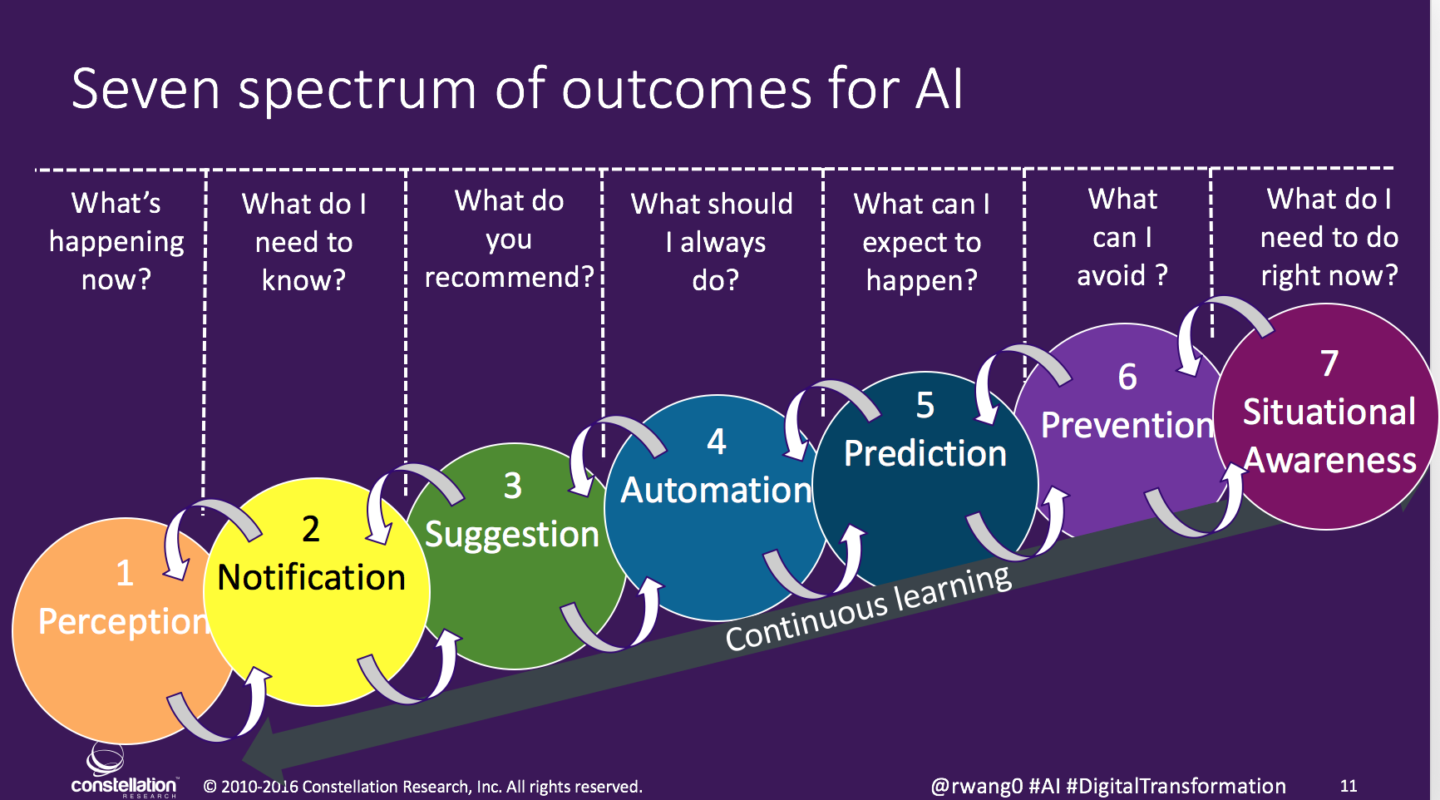
  • Seven Spectrum of Outcomes for AI

    Ray Wang has an interesting post up titled Understand The Spectrum Of Seven Artificial Intelligence Outcomes. From the post, here are the seven:

    1. Perception – What’s happening now?
    2. Notification – What do I need to know?
    3. Suggestion – What do you recommend?
    4. Automation – What should I always do?
    5. Prediction – What can I expect to happen?
    6. Prevention – What can I avoid?
    7. Situational Awareness – What do I need to do right now?

    rwang0-spectrum-of-outcomes-for-ai-1440x800

    Just think of how artificial intelligence is applied to every B2B SaaS application using these seven questions as a thought exercise — there are so many amazing possibilities.

    It’s a great time to be an entrepreneur.

  • Thinking About SaaS Run Rates and Renewal Rates for the New Year

    One of the great things about SaaS is that the new revenue layers on top of existing revenue such that the new year starts with a baseline of business even if nothing new is sold. As I talk to entrepreneurs and ask about 2017, they like to talk about revenue going from X to Y next year (e.g. $1M to $2M). Then, I ask about their annualized renewal rate, which is often in the 70% – 90% range (anything above 90% is amazing). Taking that annual renewal rate and multiplying it by the end-of-year run rate is a better way to think about the starting point for the new year.

    Here are a few thoughts on the SaaS run rate for the new year in the context of the renewal rate:

    • Most of the time, the renewal rate with existing customer expansion revenue layered on is well below 100% (meaning, if no new deals are sold in a calendar year, the company would shrink as opposed to some startups which are great at growing existing customers and continue to grow even if they didn’t sign new customers)
    • Thinking about the run rate times the renewal rate as the starting point creates a more realistic baseline for the new year (e.g. $10M run rate and 80% renewal rate with a goal of hitting $15M by the end of 2017, it’s better to think of starting at $8M and needing to add $7M of new revenue to get to the 2017 goal even though it’s conservative since the 20% that cancel won’t do so on day one)
    • Talking about the new year run rate with a renewal rate context drives home the importance of product development, customer success, support, etc. in delivering an amazing experience where customers will not only renew, but they’ll also want to expand

    Entrepreneurs would do well to incorporate renewal rates into their high level thinking about going from revenue run rate A to B for the new year. Often, the delta between the two is higher that what’s already contemplated.

    What else? What are some more thoughts on incorporating renewal rates into thinking about run rate goals and the new year?

  • X Orchestration Platform

    After yesterday’s post on the Marketing Orchestration Platform, a friend rightly pointed out that the orchestration platform is applicable to all the major functions. Sales? Check. Customer success? Check. Product? Check. And the list goes on. The explosion of SaaS apps has made for a number of siloed systems, some department specific and some that span departments.

    Several years ago I worked on an idea to bridge the gap on the data side between disparate cloud apps and learned a number of good lessons. My two main takeaways were a) being a “dumb” pipe doesn’t engender enough value and b) tier one app integrations, which have the most value, are eventually built internally by most vendors. Now, an X Orchestration Platform adds much more value than integrating data, and that’s why it’s interesting.

    Look for the number of SaaS tools to grow and the opportunity for X Orchestration Platforms to grow as well.

    What else? What are some more thoughts on the idea that all major function areas now use a variety of tools presenting an opportunity for an app to act as an overlay for them?

  • Marketing Orchestration Platform

    After sharing the story of 27 SaaS Products for the Marketing Department with an entrepreneur, I got to wondering if there’s going to emerge a new category of product: marketing orchestration platform. Today, marketing departments run as a federation of specialized functions managed by a central project management app like Trello or Asana. Only, the project management app is just for the projects, not for coordinating all the moving parts.

    Here’s what a marketing orchestration platform might do:

    • Connect via APIs to the major applications used by marketing
    • Automatically show all campaigns/programs/processes running
    • Collect all the relevant metrics and data for processing and visualization
    • Apply machine learning to the data and make recommendations
    • Facilitate coordination and timing of on-going programs
    • Profit!

    Then again, it might be too complicated and cumbersome and make all that happen elegantly. If someone can pull it off, it feels like a gap in the market. I’m curious to see if a standalone product emerges or if the marketing automation vendors get better at becoming a platform that other apps integrate with (the same way Salesforce.com has done) and marketing automation becomes the marketing orchestration hub.

    What else? What are some more thoughts on a marketing orchestration platform?

  • The Value of Being Top 3 in a Market

    Recently an entrepreneur asked me why we didn’t raise venture capital at Pardot. My immediate response is always that we did the spreadsheet jockeying to see if was worth it, and it wasn’t (the Value Multiplier to Raise VC Money is 5 and 99% of Entrepreneurs Shouldn’t Raise Venture Capital). Only, in hindsight, there was another element that we achieved, yet I didn’t understand the importance: we needed to be one of the top three vendors in the market to stay relevant. Luckily, we were able to stay relevant without venture capital, but for SaaS startups that need to be in the top three of a market, venture capital is often required.

    Here are a few thoughts on the value of being top three in a market:

    • Growth – The top vendors grab a disproportionate share of the market, and grow faster than the market. Ultimately, growth is what defines a startup, so being in the first tier of vendors is required (see A Startup is a Scalable Growth-Focused Company).
    • Brand – More customer wins results in more word of mouth referrals, more customer stories, and more money for marketing, all critical to building a brand. Success and scale help the virtuous cycle of building a brand.
    • Acquirers – If the entrepreneur does decide to sell, acquirers, of which there are very few (see Odds of Raising Venture Money and Selling for $100M+) want a leader in the market. Being in the top flight of vendors significantly increases the odds of a successful exit.

    Entrepreneurs would do well to figure out how to be one of the top three vendors in the market. Most markets aren’t winner-take-all or winner-take-most, but the top three vendors often win an out-sized share of the market.

    What else? What are some more thoughts on the value of being in the top three in a market?

  • Gaps in Marketing Technology

    Recently I was talking with an entrepreneur about marketing technology — a space he knows well — and he said that because of so much capital going into the space, there aren’t that many gaps. Hmm, I thought, there are a number of gaps where leaders haven’t emerged. Most segments have vendors in them but that doesn’t mean a group of tier 1 vendors have emerged.

    Here are some big picture gaps in marketing technology:

    • Simple Marketing Automation – Marketing automation is powerful, valuable, and too complicated for many marketers. There’s plenty of opportunity in certain segments.
    • Full Account-Based Marketing – Lots of vendors are doing parts of the puzzle but there’s not a comprehensive solution. This market is harder than it looks but there are still big gaps.
    • Deep Online Behavior Understanding – People are tracked online much more than they realize. Only, beyond the basics (which are 100x better than no data), there isn’t deep understanding of user behavior and patterns.
    • Marketing Orchestration – Marketing has an incredible number of tools (see 27 SaaS tools in the marketing department). What system orchestrates them all?

    These are a few of the gaps in MarTech that I expect to be addressed over the next five years.

    What else? What are some other gaps in the marketing technology landscape?

  • 3 Quick Ways to Value SaaS Startups

    Recently an entrepreneur was asking about SaaS valuations for startups. Valuations, especially in startups, are often all over the place as there isn’t a liquid market and the value is generally whatever the most someone is willing to pay. With that said, here are three quick ways to gauge the value of a SaaS startup:

    • 3 – 5x Annual Run Rate – Assume that the terminal valuation for a SaaS company is a multiple of cash flows, and that a true SaaS company can have 50% net margins if sales and marketing were significantly cut, resulting in this simple valuation range.
    • 3 – 5x Annual Run Rate in 12 Months – For startups growing > 50% per year, there’s a big premium and the common way to do it is based on a multiple of the expected run rate 12 months from now (by being forward looking, it takes into account the growth rate).
    • Typical Investor Check Size Times 4 – When raising a round, take the size of check the investor typically writes — say $3 million — and multiple it by four resulting in a post-money valuation of $12 million, reflecting the investor owning 25% of the business. Early institutional investors typically target an ownership of 20 – 30%, so that valuation is driven more so by the check size and target ownership rather than a multiple of run rate.

    Valuations rarely go lower than this and sometimes go much higher for unique circumstances. Valuations, especially in startups, are much less scientific than it appears.

    What else? What are some quick ways to value a SaaS startup?

  • Local, Fast-Growing Million Dollar Revenue SaaS Startups

    Earlier today I was talking with an entrepreneur and the topic of the $1 Million Annual Recurring Revenue Milestone came up. After thinking about it more, I realized I could name 10 Atlanta B2B SaaS startups that had hit this milestone in the last 18 months, and every one is still growing fast. As a community, this bodes well for several reasons:

    • Some small percentage of these startups are going to scale and turn into large companies (hopefully, even an anchor technology company)
    • Look for some really nice exits from this group over the next 3 – 5 years creating more success stories and local wealth
    • More successful startups will train more of the next generation of entrepreneurs contributing to the virtuous cycle
    • More institutional capital will come to the region since traction is one of the key elements for this type of investor

    There’s a great class of local, fast-growing million dollar revenue SaaS startups that are going to make a real impact on the Atlanta startup community — I’m excited for the future.

    What else? What are some more thoughts on the benefits of fast-growing million dollar revenue SaaS startups on a local community?

  • Predictive Sales and Marketing Data Sources

    Continuing with yesterday’s post on Predictive Sales and Marketing Technologies, one of the areas to go deeper is the sources of data that can be used for scoring lead/contacts as well as building out the lookalike companies for targeting. One of the reasons predictive sales and marketing technologies are so good now is that number of quality data sources available is much larger than 10 years ago.

    Here are a few of the predictive sales and marketing data sources:

    • Demographic – Different personas with attributes like job title are valuable when building predictive models
    • Firmographic – Characteristics of the company like size, industry, and location are key data points
    • Social – Significant amounts of publicly available information on social media include location, frequency, interests, and more
    • Technographic – Technologies implemented in a company and on their website (e.g. web server, CMS, marketing automation vendor, etc.) provide a unique profile of the business
    • Digital Behavior – Marketing automation tracks page views, email opens, ebook downloads, and every other digital fingerprint — all useful for understanding the ideal buyer

    Modern data sources combined with machine learning make predictive sales and marketing possible. Look for the quality and quantity of data sources to grow making predictive technologies that much better.

    What else? What are some more data sources for predictive sales and marketing technologies?