Category: Strategy

  • Ideas for Researching a Market

    Earlier this week I was talking with an entrepreneur who was thinking through a new idea. In addition to customer discovery and working to assess the market need for the product, we also talked through a few different ideas for researching a market.

    Here are a few tactical ideas to gather information on a market:

    • Find at least five competitors and build a spreadsheet of data points like number of employees in LinkedIn, amount of money raised via CrunchBase, and approximate site traffic via Compete
    • Evaluate three competitive products (sign up for a free trial or find a referral to a customer)
    • Interview 10 customers of the competitors and figure out three things they like and three things they don’t like about the product and company
    • Read at least 10 white papers and/or blog posts from industry analysts like Gartner, Forrester, or an independent researcher
    • Attend two industry tradeshows, walk the show floor talking to all the vendors, attend the sessions, and network in the hallways

    Market opportunity, especially timing and size, are some of the most important considerations when deciding on an idea and starting a company. Customer discovery is critical, but it’s also worthwhile to do other types of market research.

    What else? What are some of your favorite ways to research a market?

  • Starting vs Scaling a Startup

    When people think of joining a startup, they often think of tech companies with cool offices and lots of chaos. While that’s often true, I think it’s even more important to distinguish between startups starting out and startups scaling, as they are incredibly different.

    Startups starting out have much more uncertainty, are tiny in size, and need to pivot or iterate a number of times before figuring out product/market fit and a corresponding repeatable customer acquisition process. It’s hard to forecast and accurately plan without operating history and metrics, which further contributes to challenges, and potential excitement.

    Startups scaling are executing against a proven plan, have product/market fit with a repeatable customer acquisition process, are well capitalized (or could be if they so choose), and are focused on maximizing growth. Every little process is an opportunity for improvement and overall energy is spent optimizing, rather than discovering.

    The next time someone says they want to join a startup, coach them on the differences between a startup starting out and a startup scaling up.

    What else? What are some other differences between a startup starting and startup scaling?

  • Figure Out How to Stay in the Game Long Enough to Win

    One aspect of entrepreneurship that’s taken me years to grasp is the importance of staying in the game long enough to win. What I mean by that is it’s incredibly hard to time a market, and timing is one of the most important aspects for major success. If it’s hard to time a market, and timing is so important, it follows that it’s best to pick big markets and give yourself enough runway to zig and zag within the market to find the greatest opportunities. In a sense, the goal is to experiment in a large target market so as to create your own timing for whatever is the best path.

    Here are a few thoughts on staying in the game long enough to win:

    If this sounds like a tough situation, that’s because it is. Startups are incredibly hard and figuring out how to survive so that you can be at the right place at the right time makes all the difference.

    What else? What are some other thoughts on figuring out how to stay in the game long enough to win?

  • A Gap in the Market Doesn’t Imply an Absence of Competition

    I love when entrepreneurs come in saying that there isn’t any competition for their idea. No competition? No way. There’s always competition. And, competition is a good thing. If there wasn’t competition, there wouldn’t be other people that believe in the opportunity as well.

    Now, just because there’s competition, it doesn’t mean that there aren’t gaps in the market. Look at the marketing automation market six years ago. Strong companies like Eloqua were doing well addressing the mid-to-high end segment of the market, but when it came to the small-and-mid sized segment of the market, there wasn’t much activity. Yes, you could buy Eloqua Team Express Light (that’s really what they called it at the time) and get a product for $1,500/month, but it wasn’t feature rich since it wasn’t the market they really cared about. Pardot filled a gap in the market for SMB companies that wanted a complete solution in the $500 – $1,000/month range.

    A gap in the market doesn’t imply an absence of competition. Rather, competitors exist and are focused on a different segment that they find more appealing. With time, many large, meaningful markets actually have several winners that carve out their own segment and dominate.

    What else? What are your thoughts on gaps in the market and competitive dynamics?

  • The Indirect Revenue Model App

    There’s a popular web pundit quote, “If you don’t pay for the product, you are the product.” Think about a company like Twitter or Facebook — they don’t charge to use the app but they make money by turning you, the user, into a product to market ads on behalf of the the advertiser. While this makes sense, there are actually a number of apps out there that aren’t what they seem when it comes to their primary revenue stream. Here are a few app examples:

    • Lead Gen Apps – Often micro-apps, these are simple services that provide some value in exchange for personal information for a sales rep to follow up and sell something else (see Micro Apps as Next Generation Content Marketing)
    • Transaction Apps – Even if an app has a monthly fee, there are many products out there that actually make more money off of transaction fees (e.g. pay $50/month to be a customer and then pay 10% for each payment collected resulting in more revenue from the transaction fees than the recurring monthly fee)
    • Secondary Apps – Some apps are built and sold as stand alone products, but they are really designed to fill in the gaps for a complementary app. This often happens when a technological shift has occurred and the original app can’t be adapted with the required changes, making it more cost effective and less painful to build a new app that takes advantage of the improved technology while supporting the original app.

    Product pricing and the main revenue stream for an app aren’t always what it seems. Pay attention to indirect revenue model products and figure out the true strategy.

    What else? What are some other examples of indirect revenue models?

  • Simple is Difficult for Entrepreneurs

    Many startups talk about keeping things simple, almost like a badge of honor. When trying to solve a problem, present a message, or interacting with a user, complexity is the natural response. Humans, especially engineers, enjoy providing comprehensive solutions that meet the needs of as many people as possible. Or do they? On average, making something simple and good is much harder than making something merely good.

    Here are several areas where I’ve seen startups have difficulty with simple but good:

    • Elevator Pitch – More often than not, elevator pitches are too complicated and don’t leave the recipient with a decent understanding of the idea (see Offline Analogy to Describe a Startup)
    • Messaging – Quick, go to five startup sites and read their homepage or most recent press release. How clear is the message? How much jargon and corporate-speak is used? Overwhelmingly, startups struggle with clear messaging.
    • Metrics – Typically, too many numbers are tracked making the important metrics less meaningful and rendering the other metrics more likely to be glossed over (see Metrics Tracking Based on Startup Scale)
    • User Experience – Often, the user experience is the most difficult to make simple and still good. Making a product intuitively obvious to the casual user is more art than science, and few people understand it.

    Delivering simplicity that is also high quality throughout a startup is hard. Very hard. The best entrepreneurs follow the idea of Occam’s Razor: “simpler explanations are, other things being equal, generally better than more complex ones.”

    What else? What are some other areas that startups have difficulty delivering simple but good?

  • The 10x Improvement Challenge

    Entrepreneurs have an innate ability to solve problems and continuously find ways to make things better. I, like many entrepreneurs, have a tendency to look for incremental improvements e.g. let’s figure out how to shorten the sales cycle from 43 days to 42 days. Instead, entrepreneurs need to challenge themselves to find 10x improvements.

    Here are a few examples of potential 10x improvements:

    • Cold Calling – Say your reps are doing 30 dials per day and getting three conversations per day. What if you implemented a service like ConnectAndSell and did 300 calls per day and had 30 conversation per day per rep?
    • Marketing – Say your cost per marketing qualified lead (MQL) is $200. What if you truly invested in great content (not average content) for inbound marketing and drove the cost per MQL to $20?
    • Support – Say your customer support team processes 100 tickets per day. What if you revamped the product’s user experience and associated help/training materials such that customers had a much better experience and support tickets dropped to 10 per day?

    The next time you want to improve something, stretch your brain and look for ways to make it 10x better and not 10% better.

    What else? What are your thoughts on the 10x improvement challenge and what are some more examples?

  • When an Exit Strategy Discussion is Required

    When asked about an exit strategy, my favorite response is that we don’t have an exit strategy — we’re building the company to be successful over the long-term and aren’t building it to sell. Of course, if someone comes by and offers a number that’s too good to be true, naturally we’d look at selling the business. Now, some investors will want a more detailed discussion of an exit strategy, so it’s important to have a plan when raising money. Here are some thoughts on an exit strategy discussion:

    • Pick five transactions in the same or similar space that have happened in the past 24 months and be prepared to talk about the financials for each (e.g. revenue, profitability, number of employees, value at time of exit, etc)
    • Choose five likely acquirers and explain why they’d pay a strategic multiple to acquire the business
    • Articulate the startup’s special sauce that makes it desirable (e.g. unique technology, great execution, amazing culture, etc)

    Exit strategies are an important discussion topic when talking with investors that want to understand the perceived value of the business down the road. What else? What are some other thoughts on an exit strategy?

  • The Elusive Product / Market Fit

    Product / market fit is much more difficult than it sounds. On the surface, the idea seems straightforward: build and refine a product that meets the needs of a market. Only, when in the arena battling to find success, it becomes readily apparent that finding product / market fit is a challenging grind (see 5 ways to identify product / market fit).

    Here are a few thoughts on the elusive product / market fit:

    Finding product / market fit is a process that often takes 1-2 years. And, because it takes so long, there’s an extended period of time with little revenue, so it’s important to plan for a marathon and not a sprint.

    What else? What are some other thoughts on the elusive product / market fit?

  • Identifying a Problem and Finding a Solution From Another Industry

    In yesterday’s post on 10 Free Business Ideas from Idealab’s IdeaDay, the last idea, Opti-Park, came after identifying a problem in one area and finding a solution for it from a completely unrelated area. Bill Gross, the founder of Idealab, commented that Idealab has 40,000 square feet of office space in the Old Town part of Pasadena. According to building code, they can double the size of their own facility to 80,000 feet, but to do that they are also required to add four parking spots per 1,000 square feet of space. Only, land is expensive, super expensive and there’s no room.

    Naturally, the ideal solution would be to squeeze more parking spaces out of the existing parking deck and surrounding parking lots. Unfortunately, no good solution had emerged until a fortuitous trip to NYC. There, Bill encountered a building using the new intelligent elevator system whereby a passenger keys in their desired floor from the elevator lobby, waits for a designated elevator, and rides the highlighted elevator to a specific floor. Inside the elevator, there aren’t any floor selection buttons — everything is controlled from the elevator lobbies. The end result is shorter elevator trips and a much more efficient use of resources.

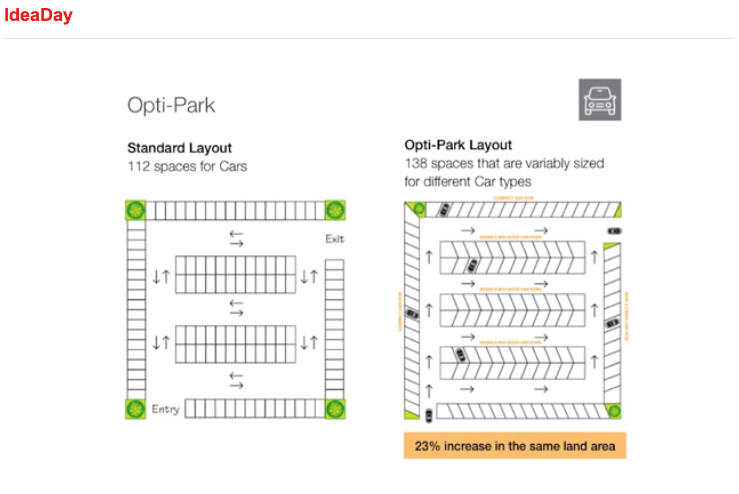
    After experiencing the intelligent elevators, the idea came to Bill to do the same thing for parking lots and parking decks. Imagine pulling up to a parking lot gate, a computer instantly calculating the dimensions of your car, and issuing a slip of paper to park in a designated spot (e.g. D4). Upon receiving the slip of paper, the driver knows exactly where to go and doesn’t drive around aimlessly until they encounter the first open spot, which may or may not fit their car. Of course, the big benefit is striping the lines of the parking deck for a variety of car sizes such that it can hold several more cars (in Bill’s example he cites one lot being able to hold 23% more cars). Eventually, the lot can be designed to not have any painted stripes but rather have LED lights that can change dynamically to maximize parking efficiency — so many amazing opportunities.

    OptiPark more efficient layout

    Overall, the takeaway is to keep a list of problems encountered in a Google Spreadsheet so that when solutions emerge in different areas, it becomes more automatic to apply them to other opportunities.

    What else? What are your thoughts on identifying a problem and finding a solution from another industry? Do you have any examples of this?