Category: Entrepreneurship

  • Signs the Economy is Picking Up

    Every week I have the opportunity to talk to entrepreneurs and hear the good, and the bad, about their business. Naturally, entrepreneurs are an optimistic bunch, so it’s important to peel back the layers and get a deeper understanding of reality. Over the past month, I’ve seen several signs the economy is picking up:

    • Entrepreneurs with non-tech businesses are reporting solid growth and many are on pace for their best year ever
    • Multiple tech entrepreneurs have recently told me their business is at break-even or near break-even, providing more options for the future, like growing the company without more/any outside capital
    • Two entrepreneurs in the past week told me they are tired of being on cruise control with their business and are ready to put more resources into growth
    • On my 1.6 mile drive to ATV, there are five houses under contract and four new ones being constructed from the ground up

    This is a small sample size but things are picking up nicely. I’m optimistic for more growth on the horizon.

    What else? Have you seen signs the economy is picking up?
  • Food for My Soul or Help by Volunteering on the Front Line

    Today, two separate entrepreneurs mentioned to me another category I had missed in my post on Developing a Rhythm for Life: community service. Each entrepreneur presented it in a different light.

    The first entrepreneur said as part of a life rhythm he’d recommend volunteering on the front line of a non-profit. His point was that as a successful leader it’s easy to serve on non-profit boards and be abstracted from the real work. Rather, by serving in the trenches of a non-profit, you get an opportunity to experience the gift of giving back in a more meaningful, personal manner.

    The second entrepreneur, completely unrelated to the first, offered up that being heavily involved in a large non-profit, and serving as the board chairman, is food for his soul. He talked about his excitement and sense of fulfillment seeing positive change in peoples’ lives. As an ambitious entrepreneur, he’s done very well for himself, yet he spends a significant amount of time giving back.

    So, when thinking about the rhythm of your life, consider community service and non-profits in there as well.

    What else? What are your thoughts on food for my soul and help by volunteering on the front line?

  • 5 Challenges for Automation in the API Economy

    TechCrunch has a piece up today by Alex Williams titled Speed and Automating the Connections Between Humans and Machines in the API Economy. In the article, Williams argues that speed of an API, especially under large load, is a real challenge, just like scaling a large website (they are in fact very similar with APIs potentially having more write load than read load, in some cases). In addition to speed, he highlights automating the connections between APIs as a challenge, where automating means integration and connection of disparate systems.

    Peeling back API automation to a more detailed level, here are five challenges I see:

    • Data Interoperability – Synchronizing data between different systems is challenging due to different standards in types of data allowed (e.g. challenges with date/time stamps, number of characters allowed, translating fields like ‘GA’ to ‘Georgia’, etc)
    • API Authentication – While there are standards like OAuth and OAuth 2.0, many APIs were built before the standards were established and have their own form of authentication, requiring more effort to integrate as well as more ongoing maintenance
    • Recent Data Polling / Ping Backs – To connect disparate systems there’s a requirement to constantly check for recent data, or set up a ping back to be notified of new data, only many systems are still immature when it comes to this functionality by simply returning all data or only returning data in a paginated form (instead of being able to query against a specific data/time)
    • Bidirectional Syncing – It’s fairly straightforward to set up one-way syncing where one system is the master and the other system only takes, but doesn’t give data. Things become much more complicated when true bidirectional syncing is required and data can flow either way between system.
    • Custom Fields / Ad Hoc Customizations – Many of the more powerful systems, including Salesforce.com, allow for infinite customization, which makes for more complexity when trying to integrate products.

    The API economy is going to be a major driver of innovation over the next 5 – 10 years, and getting the automation piece right is a big opportunity.

    What else? What are some other challenges for automation in the API economy?

  • Developing a Rhythm for Life

    Following up on the Notes from John Paul DeJoria, there was an area that I wanted to explore further. DeJoria talks about his personal rhythm, including taking a solo retreat each year to the mountains for a couple days to ask questions like what am I doing and what do I want to be doing. Personally, I don’t take a solo retreat but I think it’s a great idea.

    There are a number of things I do for my own rhythm:

    • No iPhone or laptop in the morning for the first 30 minutes
    • No more than one breakfast meeting and one evening meeting per week
    • Weekly exercise of at least 90 minutes
    • Weekly date night with my wife
    • Weekly adventure with only my kids
    • No more than one week of business travel per quarter
    • Quarterly week-long out-of-town family vacation
    • Annual review of personal, family, and professional goals

    I’ve talked many times about developing a rhythm in business and I think it’s even more important to develop a rhythm for life.

    What else? What are some other items that are part of your own rhythm for life?

  • Notes from Inc.’s Interview of John Paul DeJoria

    This month’s Inc. magazine has a fascinating “The Way I Work” with John Paul DeJoria. DeJoria is the founder of John Paul Mitchell Systems, Patrón Spirits, and several other companies. Forbes listed his net worth at $4 billion.

    Here are a few notes from the John Paul DeJoria interview:

    • Doesn’t use email or a computer (everything done via fax, phone, and in person)
    • Management philosophy: pay attention to the vital few and ignore the trivial many (I love that line)
    • Every product gets reviewed by him personally, even flea and tick shampoo
    • Personal chef makes lunch for him daily
    • Every employee at Paul Mitchell and Patrón gets free lunch daily because he believes you have to treat your people well
    • Motto: success unshared is a failure
    • Takes a personal retreat annually and asks the questions what did I do last year, who is in my life, what am I doing, and what do I want to do

    My favorite line, as mentioned above, is the one about paying attention to the vital few and ignoring the trivial many. I don’t know too much about John Paul DeJoria but I found the interview fascinating.

    What else? What are some of your thoughts on his approach to life?

  • Life as a Tour Guide of the Startup World

    Last month I attended a behind-the-scenes family event at the Atlanta Zoo. There were about 30 business leaders with their families and we were divided in five groups of six to be lead by an experienced tour guide. After 90 minutes with the guide, I had a new found appreciation for many of the exhibits as well as the effort required to make the zoo run smoothly (seeing a variety of frozen animals that were food for other animals was especially eye opening).

    After the zoo event, I began thinking about my role as one of many tour guides of the startup world with the Atlanta Tech Village. So many community leaders and entrepreneurs have reached out to see the facility that I’ve been honored to walk them around and explain how we’re actively changing the trajectory of the entrepreneur community in a great way. For many of them, it’s the first time they’ve seen startups in the wild.

    Here are some of the comments and questions I hear as a startup world tour guide:

    • Wow, the energy and excitement is palpable
    • People are so happy and friendly
    • I didn’t realize there were so many startups in Atlanta
    • What’s the average age? Answer: 30
    • How does any get work done with all the ping pong tables, Xboxes, and scooters? Answer: work hard, play hard
    • How many members are there? How many startups do they represent? Answer: 250+ / 80+
    • How big of a startup does the facility support? Answer: 30+ people

    As expected, life as a tour guide of the startup world is pretty special. Being surrounded by people chasing their dreams, and acting as a conduit to the non-startup world, makes for a great experience.

    What else? What are some other thoughts on life as a tour guide of the startup world?

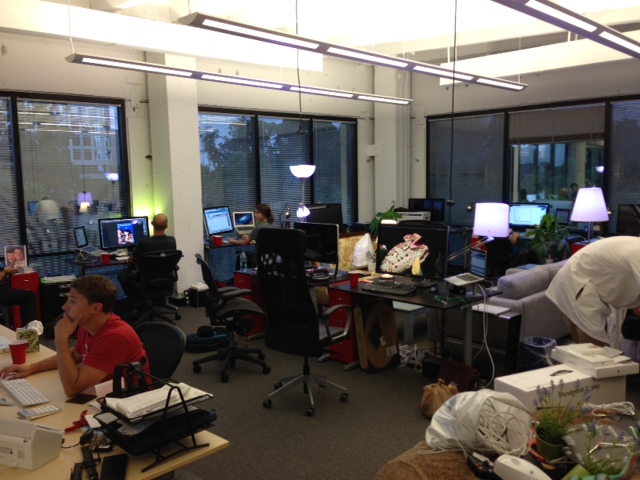
  • Week One With an Open Floor Plan Office Environment

    We’re almost a week into our open floor plan arrangement and I must say that things are better than expected. I knew it would increase communication, and distractions, but the value of sharing information and helping each other out has outweighed the cons. Just being in the room has energy and excitement in the air — mostly a testament to the culture and quality of our people, but also related to the work environment.

    Way back in May of 2010, Jeff Hilimire blogged that’d he’d never go back to private office again. I remember reading that the day he wrote it and thinking to myself that I’d like to try that out as well. Well, three years later I finally made it happen.

    Here’s what I’ve learned so far with an open floor plan office environment:

    • Collaboration and talking amongst team members goes up (as expected)
    • People follow our posted best practices guidelines (respect those around you, no talking on the phone in the large rooms, headphones on means do not disturb, etc)
    • Private meeting rooms are always available with a ratio of one room for every five people (I haven’t seen more than four of the eight meeting rooms used at any given time)
    • Tasks which require long, uninterrupted focus I take to a private room or a different area

    My biggest takeaway is that the open floor plan environment works best in conjunction with a Results Only Work Environment (ROWE) philosophy. When team members are empowered to get their work done in a matter best suited to how they like to work, an open office floor plan is just one of many options.

    Here’s a photo:

    open floorplan office

    Some of the highlights included tons of natural light, exposed ductwork with 12 foot ceilings, drop lights that shoot light back on the white ceiling so that there’s all indirect light in the room, retractable power cords mounted on the ceiling for maximum flexibility in rearranging desks, and carpet on the floor to absorb sound. Overall, the space looks amazing and I’m excited how it turned out.

    What else? What other experiences do you have with open floor plan office environments?

  • Health IT and the Atlanta Tech Village

    Atlanta is the health IT capital of the United States with 200+ health IT companies and nearly $4 billion in revenue (source). At the Atlanta Tech Village, we have several health IT companies like Rimidi Diabetes, DocTime, and Digital Assent / PatientPad. As part of our theme of playing to the existing strengths of our community, we see an opportunity for more health IT at ATV.

    Here are a few ideas around health IT and the Atlanta Tech Village:

    • Find a partner to run a health-related accelerator program like Rock Health or Healthbox
    • Help someone create a health IT variant of the Atlanta Startup Village and have open monthly or quarterly events where health IT entrepreneurs give their five minute pitch followed by audience Q&A
    • Encourage health IT groups and associations to use ATV facilities and help grow the number of active participants in the community

    Health IT is a big part of the Atlanta tech and startup communities. ATV wants to do what it can to help.

    What else? What are some other thoughts on health IT and the Atlanta Tech Village?

  • Good Ideas Come From Internal Challenges

    One of the best ways to come up with entrepreneurial ideas is to look at internal challenges. Every company has problems and opportunities that aren’t being met, some more obvious than others. Here’s a simple exercise: take the three smartest people in your organization that you have good rapport with and ask them about their three biggest challenges. With these nine challenges in hand, whittle them down to your three favorite. Now, reach out through friends and acquaintances to do customer discovery (example guide) as to which one has the most opportunity. Voila, there’s a potential business idea.

    Here’s how my entrepreneurial endeavors evolved:

    • Built websites in high school and college and couldn’t find a good content management system, so Hannon Hill was born
    • Had limited visibility into sales and marketing effectiveness at Hannon Hill, so Pardot was born
    • Had a tough time connecting Pardot to other cloud-based apps to exchange data, so Kevy was born

    The next time someone says they want to be an entrepreneur but don’t have a good idea, take them through this simple process.

    What else? What are your thoughts on good ideas coming from internal challenges?

  • Writing as Another Muscle You Develop – An Example Routine

    One of the more popular questions I get is “How do you write a blog post everyday?” I think the “why” question is more interesting, but the “how” comes up more often. Here’s my routine:

    • Keep a list of possible topics on my iPhone (I usually add 1-2 topics per day)
    • Major news or announcements immediately become top priority (like Salesforce.com buying ExactTarget/Pardot)
    • Review the list of potential topics and take the one that is most interesting (weekends are toughest since professional conversations are where most of my ideas come from)
    • Time box the writing of the post to 25 minutes — crank it all out and let it marinate a bit
    • If traveling, write a few posts in advance, otherwise write each post on the day it’s published
    • Find a rhythm and stick to it (my original goal was to write one post a week and I found it easier to do it daily)

    After writing daily for a month, things become much easier and it felt like I was developing a muscle. With a few years under my belt, I don’t think too much of it anymore.

    What else? What are your thoughts on writing as another muscle you develop?